For a long time, I thought we were making a wood stain. Turns out we were headlining a concert! The first thing you notice at Mission Bell isn’t the wood, it’s the light.
Cold beams cut across the floor like stage rigs warming up before a show. The laser board hums, throwing sharp lines of red light across raw panels stacked like guitars waiting in the wings. Robotic arms swing like fans at a concert. Precise, rehearsed, never missing a cue. Then the blades start.
High-speed cutters scream through wood like a crowd hitting the first note of a set. Panels move, flip, align, everything in rhythm, everything on tempo. Sawdust lifts into the air and hangs there, a low fog drifting across the line like dry ice under a spotlight. It’s a performance. And it’s fast. Until it isn’t.
Because every show has a moment where the music drops out, and here, it happens at the stain booth. The lights are still on. The machines are still ready. The crowd is still screaming. But the chemistry slows everything down. Like long enough to leave the show.
Robots can’t outrun bad chemistry. In modern finishing lines, throughput isn’t limited by equipment anymore. It’s limited by cure kinetics.
Traditional stains take hours to flash. Then more time to cure. Then more layers. Then more time. The fans lose interest and move on. Then more time to topcoat. A floor full of machines built to move at the speed of lasers ends up waiting on molecules that haven’t caught up yet.
That’s the bottleneck. That’s where the music dies. Bye bye, Ms. American Pie.
We brought WeatherWood into that moment. Ran it through the booth. Let it play. Our stain flashed in 13 minutes. Our topcoat, because nothing off the shelf would hold our colors without killing them, cured in another 20. Thirty-three minutes, start to finish. The line didn’t stop.
After the test, someone at Mission Bell looked at the panels, then at the clock, and said: “Freeing up our bottleneck at that pace would let us do another building. But remember color is king.”
That line stays with you. Because it splits the problem clean in two.
The First Half: Throughput
Factories don’t wait on machines anymore. They wait on chemistry.
Cutting a process from hours down to 33 minutes doesn’t just save time. It rewrites capacity. It changes how many jobs you can take, how fast you can move, how much you can produce before the lights go out. Throughput is math.
The Second Half: Why It Matters
“The color was king.” Throughput gets you paid. Color gets you chosen. We didn’t build another version of oak, walnut, or amber. The category already has those. We built colors for how wood actually shows up now:
• feature walls that carry a room
• ceilings that define a space
• millwork that feels like architecture, not furniture
Carbon Timber. Heritage Gray. Driftwood. Reclamation. Black Bogwood. Names that don’t describe a color, they describe a moment.
Nobody walks into a space and says: “That’s a great polymer system.”
They say: “I want my place to feel like this.”
The chemistry is what makes that feeling repeatable. Durable. Fast.
But the feeling is what makes anyone care in the first place.
Where This Goes Next
We’re heading to the American Coatings Show in Indianapolis @Booth #3178.
We’ll bring the show, you bring your credit, cause its time to rock on… the color line. But we’re also working on something that sits just offstage.
Right now, finish decisions are made through samples, guesswork, and memory. You hold up a swatch. You imagine. You hope. If you think cure times are rough, try specifying colors. We’re building toward a different moment: The ability to see the finish on the actual surface, under the real light, before the can is opened.
Not as a gimmick. As a shift in where the decision gets made. Because once the result becomes predictable, the experience around it can change too.
If you’re at ACS 2026, come find us at Booth #3178.
If you’re running a line, building a space, or specifying a project, you already know the truth: The machines are ready. The systems are fast. It’s the chemistry that makes you believe the Elvis isn’t dead. The King is alive and vibrant with color.
Meet Becca Berger, a Silicon Valley-based CleanTech coatings inventor, who is using AI, VR, Apple Vision Pro, and solar power to disrupt paint and wood stains!☀️
Why Traditional Wood Stains are so Frustrating
For years, woodworkers and homeowners have quietly suffered through one of the most reliably frustrating experiences in DIY: trying to get wood stain to look the way they imagined it would.
“People open a can of stain expecting a simple weekend project,” says Becca Berger. “Then they end up sanding boards back down because the color developed unevenly, blotched, or dried differently from one piece to the next.”
The problem, Berger explains, is built into the chemistry. Traditional oil-based stains demand precise timing, careful technique, and years of experience that most homeowners simply don’t have. The result is a consistent stream of complaints across Reddit, woodworking forums, and DIY communities: blotchy finishes, streaking, and unpredictable color.
At the same time, tightening VOC regulations are putting increasing pressure on these legacy solvent-heavy formulas.
Those two forces, customer frustration and regulatory pressure, are now colliding at the perfect moment for a new approach. That convergence became the foundation for WeatherWash, Berger’s Silicon Valley-based CleanTech coatings company.
What's the Solution
"WeatherWash takes a fundamentally different approach. Rather than relying on surface pigments, Berger’s formulation uses tannin-reactive chemistry that develops color through a controlled reaction inside the wood itself. Once the reaction completes, the color becomes stable, the wood effectively stops aging, delivering consistent color that won’t shift over time.
“The wood becomes part of the staining system,” Berger says. “Traditional stains fight the substrate. Ours works with it.”
The result is a one-coat, water-based stain that eliminates blotching, streaking, and the stressful timing issues that have plagued DIYers for decades. It’s already on shelves at major retailers nationwide, offering a cleaner, more predictable alternative to petroleum-based legacy products." 🦄
What's the Bigger Vision?
"The timing may be better than it looks. While major incumbents like Sherwin-Williams have reported their consumer brands group losing market share, participation in DIY home improvement has continued to grow. A new generation of homeowners wants the high-end Restoration Hardware look, but isn’t interested in spending Restoration Hardware money, or mastering professional-level finishing techniques.
Berger’s ambitions go well beyond the chemistry. She wants to make buying architectural coatings feel as frictionless as ordering a pizza. Today, the process is still maddeningly primitive. Consumers and contractors must navigate confusing websites and overwhelming data sheets, guess quantities, and hope the tiny swatch they chose will look right on their specific wood, all without any real confidence in the final result.
Her team is building an Apple Vision Pro platform designed to eliminate that uncertainty. Users scan their space, answer a few simple questions about the project, and see exactly how WeatherWash will look in their actual environment, before they ever hit “buy.”
What is the Difference Between CleanTech and Conventional Coatings?
"It’s ultimately an efficiency story, not just a sustainability story.
Traditional coatings were engineered around assumptions that no longer hold: inexpensive petroleum solvents, multi-coat workflows, long cure windows, and manufacturing systems designed before energy efficiency and emissions became major engineering constraints.
CleanTech Coatings follows a different methodology. It takes the category’s best-selling products and systematically reformulates them with cleaner chemistry, renewable inputs, and low- or zero-VOC processes, while reducing friction across the entire workflow. Fewer coats. Shorter dry times. Less labor. Lower energy demand in manufacturing.
Berger says, “If you can reduce unnecessary solvents, cut energy inputs, and simplify the workflow at the same time, the whole system gets better economically too.”
That convergence is the real point. WeatherWash isn’t positioned as a feel-good alternative. Berger believes it represents a more efficient industrial architecture for a category that hasn’t fundamentally changed in decades.”
How are You Building Demand Today?
"Right now, Berger is building a direct relationship with her audience through Instagram, Facebook, and YouTube. But her real ambition is much larger. She wants to own the moment of specification, the critical point when a customer is deciding exactly what to buy. The long-term opportunity isn’t just selling coatings,” Berger says. “It’s owning the specification layer that sits between the homeowner and every coatings decision inside the home."
That’s where Sherwin-Williams’ moat becomes their weakness. If WeatherWash can capture the customer at the moment they’re specifying color and materials, the traditional retail advantage begins to crumble.Their thousands of stores and sales reps are powerful, but only if the customer is willing to drive to a store. WeatherWash is betting that the next generation of digitally-savvy customers would rather configure their project in their living room using spatial computing than make a trip to the paint aisle."
Do CleanTech Coatings Perform as Well as Existing Products on the Shelf?
"Yes. WeatherWash is completely VOC-free, carries no Prop 65 warning, and contains no oil or petroleum solvents. It also delivers the fastest dry time currently available on the market, with independent PPG testing confirming a sub-13-minute dry time under controlled conditions, dramatically faster than the hour-scale dry and re-coat times of conventional solvent-heavy stains.”
The Platform Strategy: Spatial Computing and the Future of Coatings
"Berger’s answer isn’t a marketing campaign. It’s a platform.
WeatherWash is betting that the next generation of digitally-savvy customers would rather configure their project in their living room using spatial computing than make a trip to the paint aisle. She is building a spatial-computing experience, beginning with Apple Vision Pro, that collapses the traditionally messy coatings decision process into a single, frictionless workflow.
Instead of multiple trips to Home Depot and lingering uncertainty, a user scans the room. The system reads the existing wall color, wood tone, lighting, and surrounding materials, then renders accurate WeatherWash finishes directly onto cabinetry, flooring, or millwork in real time. Then the consumer gets on the Weatherwash App and orders the stain, just like people are ordering Tesla's through the app.
The homeowner who finishes their first project successfully is far more likely to attempt a second one, photograph it, share it on the app, and stay inside the coating ecosystem. Every completed project becomes marketing that reduces risk for the next buyer and creates a fly wheel effect."
Can you give me an example of how the product works?
Anyone can use a flood system, a spray gun, or a brush. Just apply the stain and let it air dry. After an hour, apply a protective topcoat and your project will be done one hour later. So, two hours total project time. This is the amount of time our typical client has to complete projects.
How did Weatherwash Get Started?
While she works, Berger tells me that two moments crystallized her thinking.
As a painter and furniture artist, she had grown increasingly frustrated with the wood-finishing systems available. “I could see the finish I wanted in my head,” she says, “but I couldn’t get the stain to give it to me.”
She began writing about those experiences on her blog and started talking directly to readers. When she asked what they really wanted from wood stain, the answers surprised her. Color mattered, but ease of use, low odor, fast dry times, and feeling safe enough to use indoors mattered just as much.
That insight changed everything. Berger realized the wood stain category had barely evolved in the past century. It was still built around chemistry and application methods designed for professional finishers. She believed there was room for a fundamentally different approach, one built for modern DIYers using cleaner, lower-VOC chemistry and simpler application.
“My hypothesis is that customer demand will ultimately shape the entire product line,” Berger says as she uses an air compressor to mix raw ingredients inside a 330-gallon tote. “With each new SKU, margins improve and we move closer to broad products that fit the market.”
How do You Plan to Cross the Chasm?
Wood stain sales are based on a commodity, so the lifetime value of a customer is attractive, but only if you can move beyond the early-adopter crowd. Berger’s plan for crossing Geoffrey Moore’s famous “chasm” is straightforward: make the product so good that the chemistry itself becomes the marketing.
"The category has barely evolved since the turn of the millennium. Most major brands still sell products and run supply chains that would look familiar to a 1999 hardware-store manager. While every other consumer category, from cars to mattresses, has been remade by digital tools, configurators, and real-time feedback loops, wood stain has remained stubbornly analog. Even AI and spatial computing feel like science fiction in a world still dominated by tiny color swatches and data sheets.
That lag is exactly why the opportunity is so large.
Every successful project posted online becomes social proof. One DIYer finishes a piece on a Saturday, photographs the result, and shares it. The next person sees real-world evidence that the stain actually works on the first try. That reduces perceived risk and brings in the next buyer. Price parity helps lower the initial friction, but the decisive factor is experience: once someone gets the high-end finish they wanted in a single weekend without the usual hassle, they rarely go back to multi-step, solvent-heavy systems.
The products themselves accelerate the loop. Customers scan a QR code on the can and instantly access application videos, project examples, and recommendations for the next coating in the system.
Since 2022, WeatherWash has generated approximately $1.35 million in wood stain sales. The path forward is operational discipline, higher throughput, lower labor and material costs, careful distribution expansion, and keeping the unit economics healthy as the business scales.
In Silicon Valley they like to say it’s not the product, it’s the category builder.
How Big is the Coatings Market Opportunity?
“The U.S. architectural coatings market, paints, stains, and finishes sold through retail channels, is roughly a $20 billion category and continues to grow steadily. Wood stain alone represents a multi-billion-dollar segment expanding alongside renovation activity, aging housing stock, and rising DIY participation.
But Berger thinks the more interesting framework is TAM expansion rather than market share alone.
“The mistake is thinking this is just a stain company,” she says. “The real opportunity is the coatings system around the project.”
Her thesis is that the behavioral shift driving demand in wood stain extends naturally into adjacent categories including cabinetry, furniture paint, topcoats, interior wall coatings, and eventually broader architectural finishes. In other words, the TAM compounds as the project compounds."
Do You Have an Economic Model?
Berger's retail model is straight forward: [(price) x (number of skus) x (number of stores) x (number of shelves) x (inventory turns) ^ Brand Equity] = Revenue.
"The real leverage comes from project compounding supported by a deliberately cohesive product system. The SKUs are engineered to talk to one another, each formulation references and complements the next, under one simple labeling convention. This unified, easy-to-understand system guides and educates the customer as they move from one project to the next, turning a single purchase into a high-lifetime-value customer.”
Who is Your Core Customer?
"Berger’s target customer is the LOHAS (link) segment, Lifestyle of Health and Sustainability. These values-driven, educated consumers want high-end Restoration Hardware aesthetics without professional skill or harsh chemicals. LOHAS prioritize one-coat application, fast cure times, low odor, and low-VOC formulations, and they make purchasing decisions based as much on values as on price.
The LOHAS market is substantial. It represented roughly one-third of home purchases in 2020 and shows strong crossover between Walmart and Home Depot shoppers. The broader LOHAS consumer segment represented a $472.5 billion total addressable market as of 2022.
What is Your Biggest Hurdle?
"Distribution. For decades the major coatings companies have controlled retail shelf space through scale, operations, and entrenched channel relationships that are extremely difficult for smaller brands to replicate. That structural advantage compounds over time.
The market is shifting underneath that structure. Kelly Moore’s exit has released significant demand back into the channel, while several large players have shifted focus toward higher-margin specialty lines. At the same time, the next generation of DIY customers is more willing to discover new brands digitally.
At WeatherWash’s current stage, the challenge is reaching the scale where operational leverage kicks in. Berger believes that once customers experience a dramatically simpler, more predictable finish, they begin to reevaluate the entire category, creating a genuine opening for newer chemistry.”
What Constraints Are You Facing as You Scale?
Becca attributes her success to lessons she learned in her MBA operations class. She has capitalized off of continuous flow manufacturing (CFM) and just-in-time delivery (JIT) processes that she learned in MBA case studies.
"Warehouse capacity and price parity are the primary constraints."
WeatherWash has scaled from gallon milk jugs on an apartment deck to 330-gallon totes, with the next step being 15,000-gallon vats.
At current volume the product carries a modest CleanTech premium ($19.97 per quart versus competitors around $15.97–$19.39). One quart of WeatherWash typically replaces multiple quarts of traditional stain. As manufacturing volume grows and continuous-flow efficiencies improve, Berger expects to close the retail price gap, potentially landing at $14.97 or better. At true price parity, she believes conversion will accelerate dramatically because customers will simply be choosing the superior product."
What Opportunities Do You See in Tighter Coatings Emissions Regulations?
"Regulation is already accelerating the shift from oil-based to water-based coatings. California’s Air Resources Board (CARB) and stricter local districts such as SCAQMD have imposed some of the nation’s toughest VOC limits on architectural coatings and wood stains for years, forcing legacy manufacturers to reformulate or exit parts of the market.
Berger sees even greater upside if policymakers use positive incentives instead of just mandates. “Imagine if states required 25% of paint and stain sold to be carbon-free, the same way they require renewable energy on the grid,” she says. That single policy would cut emissions at two critical points: plant manufacturing and VOC off-gassing during application.
CleanTech formulations like WeatherWash are already engineered for exactly this regulatory environment."
Why Haven’t Coatings Had its iPhone Moment Yet?
“Because the industry was built around manufacturing and shelf space instead of customer experience. The next generation of coatings companies will collapse the entire workflow into a one-click system where homeowners can scan a room, visualize finishes in real time, and order products with predictable results instead of guessing from tiny swatches and technique-heavy application methods. The chemistry and the software have to evolve together for that experience to work. This is the future.”
How Does Your Manufacturing Process Differ from Sherwin Williams'?
"When Berger began designing WeatherWash’s manufacturing process, she kept returning to a line from Bill Gates’ How to Avoid a Climate Disaster: to materially reduce emissions, cleaner chemistry, cleaner manufacturing, and scalable systems all have to evolve together.
That became her operating constraint.
Legacy manufacturers like Sherwin-Williams still rely on decades-old, fossil-fuel-intensive processes. Berger took a different path. She developed a waterborne system that eliminates most VOC-heavy solvents while maintaining performance. And she insisted on proving the model could work at commercial scale, not just in the lab, WeatherWash is already in retail distribution, including Walmart.
Berger believes the next generation of coatings companies will scale differently: through lower-energy chemistry, more efficient manufacturing systems, and products designed around sustainability from the beginning rather than retrofitted later."
Weatherwash Plant
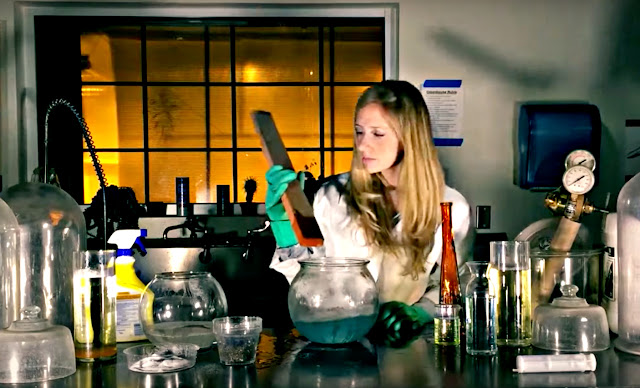
Becca tosses what looks like herbs into a large plastic tote, pinching a little of this and folding in a little of that with a wooden oar while air compressors pulse in the background. The operation feels strangely analog and futuristic at the same time, part chemistry lab, part workshop, part production line.
Are your Materials Renewable?
"Yes, and WeatherWash’s formulas use raw materials that are renewable and abundant."
Berger tracks performance by measuring gallons produced per unit of energy consumed, a practical metric for energy intensity. The goal is simple: continue reducing energy intensity, VOCs, and process emissions on the path to a genuinely lower-carbon manufacturing model."
How do Efficiencies Drive Real CleanTech?
"Efficiencies are what separate real CleanTech from green marketing.
The built environment drives a large share of global carbon emissions, so Berger focuses on five areas: raw materials, workspace efficiency, energy use, labor, and plant operations. Her goal is straightforward, maximize output while minimizing energy, waste, and process friction."
If You had One Wish, What Would it Be?
"Global scale.”
The product is ready. The application is straightforward. The customer response is real.
In coatings, distribution compounds. Every additional retail door increases visibility, lowers logistics costs, improves manufacturing efficiency, and strengthens repeat purchase behavior.
If she could accelerate one thing tomorrow, it would be thoughtful retail expansion. The chemistry is already there, it just needs the shelf space to match it."
What Would You Give Up?
"Take a look around you. Everything I have here is for sale, including things you can’t see, like equity.”
She glances at a tote that’s beginning to overflow and laughs.
“Hang tight, it looks like my staff is overflowing a tote. I gotta go. Are we done here?”
*****
Here’s what a coatings strategist would take away from a day at WeatherWash:
The chemistry is legitimately differentiated. A tannin-reactive, waterborne stain with a controlled-stop reaction represents a meaningful departure from conventional pigment-heavy systems. Stabilizing that reaction consistently across varying wood species, moisture levels, and real-world conditions is the hard part, and the defensible moat.
The brand franchise is structurally compelling. With more than 31,000 Instagram followers, exceeding both Minwax and Varathane, WeatherWash has built a highly engaged, organic LOHAS audience with virtually no paid acquisition. In a category driven by visual identity and personal taste, that community compounds over time.
But the most interesting, and potentially billion-dollar, layer is the AI-powered spatial computing platform Berger is building. Her long-term thesis is that coatings is evolving from a retail distribution business into a digitally guided specification business. The real opportunity isn’t just selling better stain. It’s owning the specification layer that sits between the homeowner and every coatings decision inside the home.
That is where the AI roadmap becomes strategically decisive. Homeowners will scan their space with Apple Vision Pro (or similar hardware). The AI reads existing colors, lighting conditions, and materials in real time, then renders photorealistic WeatherWash finishes directly onto their own cabinetry, walls, flooring, and millwork. Intelligent SKU recommendations and one-click purchasing complete the loop. Every scan and completed project feeds high-quality, proprietary training data back into the system, creating a compounding data moat that improves accuracy and personalization over time.
The chemistry is the credible wedge that makes the AI believable. The rendered finish only works if the real-world finish consistently matches the visualization, and WeatherWash already delivers on that promise.
The category itself is approaching a genuine inflection point. Legacy coatings companies remain optimized for shelf space, dealer networks, and analog retail distribution, while the next generation of homeowners discovers products digitally, forms preferences socially, and expects software-like simplicity in historically technical categories.
In that sense, WeatherWash is more than a coatings brand. The chemistry is the entry point. The AI-driven spatial platform is the infrastructure that turns it into a low-friction, high-lifetime-value consumer ecosystem capable of expanding across the entire home.
An incumbent could attempt to replicate the chemistry, rebuild the community, and develop the software ecosystem on its own. Or it could acquire a system where the differentiated chemistry and the billion-dollar AI platform already work seamlessly together.
The more interesting strategic question may not be whether WeatherWash fits inside a coatings portfolio, but whether future coatings portfolios can afford to compete in a world of spatial computing and AI-assisted specification without a platform like this.
"I hate that word... DOWN! I'm on the way up! When you see someone walking high... it's me!" said The "Unsinkable Molly Brown." I love that movie! First female entrepreneur to get a musical done in her high honor. I'm watching it right now, which is so fitting for what I'm about to tell you.